1Xbit South Africa is a crypto friendly sportsbook offering extensive markets, high limits, and fast blockchain based payments.


 Good choice of eventsDifferent types of support availableAmazing mobile app
 Withdrawal time can change









1xbit South Africa sits in a very particular corner of the betting world: a fully crypto-driven sportsbook that leans hard into anonymity, depth of markets, and high-frequency wagering. In my experience, it feels closer to a trading terminal than a traditional local bookmaker, and that is exactly what appeals to a certain slice of South African bettors who are already comfortable with crypto rails and self-custody wallets.
Operationally, 1xBit runs as an offshore crypto sportsbook that accepts users from many jurisdictions, including South Africa, without routing anything through local banks or card schemes. When you access the site from here, you are effectively connecting to an international wallet-based platform that treats every account in crypto terms, with balances mirrored in different coins rather than in rand. This is why you will never see a ZAR toggle in the cashier; the system is built from the ground up around blockchain assets.
From a technical standpoint, South African users connect via standard HTTPS and interact with the same backend as the rest of the world, where settlement logic, pricing algorithms, and risk models are centralised. Within that shared framework, 1xbit SA access is essentially just one more region hitting the same APIs, while the financial layer is handled exclusively through deposits and withdrawals in cryptocurrency, which are then reconciled through their internal ledger rather than through payment methods that rely on traditional banks or card processors, giving the operator more control over security, velocity, and user data exposure on every transaction.
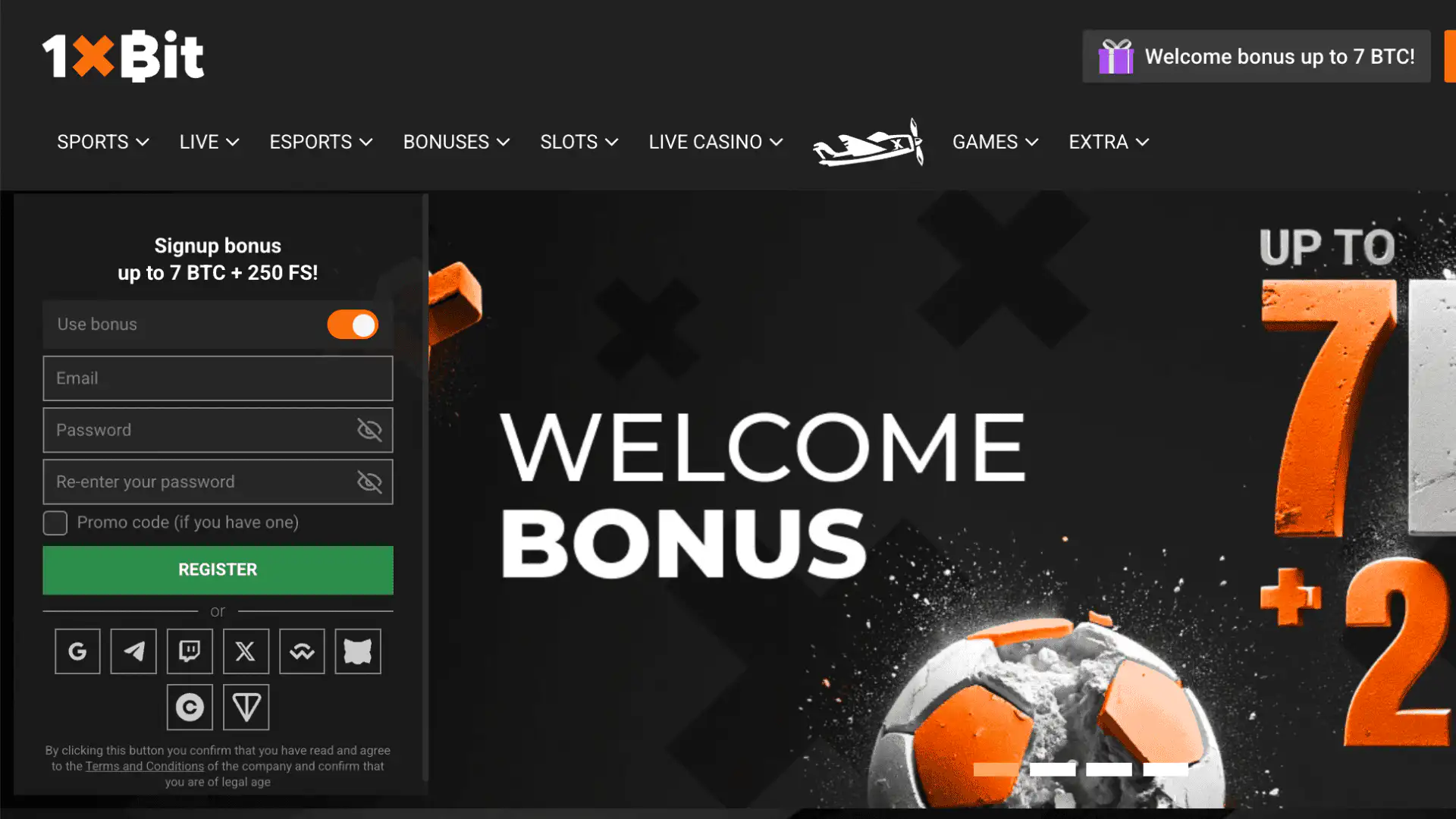
Signup is noticeably minimalist. Instead of filling in a long registration form, you receive a generated account ID and password, which you are advised to store securely. No email or phone number is mandatory upfront, which is a stark contrast to South African-licensed sites that require identity checks from the outset. In practice, this means you can be placing bets within minutes of landing on the homepage, provided you already have crypto ready to send.
That anonymity comes with both perks and caveats. On the positive side, your betting activity is decoupled from local banking rails, and there is less friction around account creation and limit changes. On the other hand, support workflows, dispute resolution, and long-term account recovery become more complex when there is little personal data attached to your profile. I have seen cases where users misplace their credentials and then struggle to re-establish control simply because there is no email address for verification.
For South Africans, the key operational difference is the absence of any fiat rails at all. There are no card deposits, EFT options, or instant EFT integrations. You bring funds in via crypto, you manage your bankroll in crypto, and you withdraw in crypto. That design has implications for tax reporting, volatility management, and budgeting that every bettor has to consider before making 1xBit their primary home for wagering.
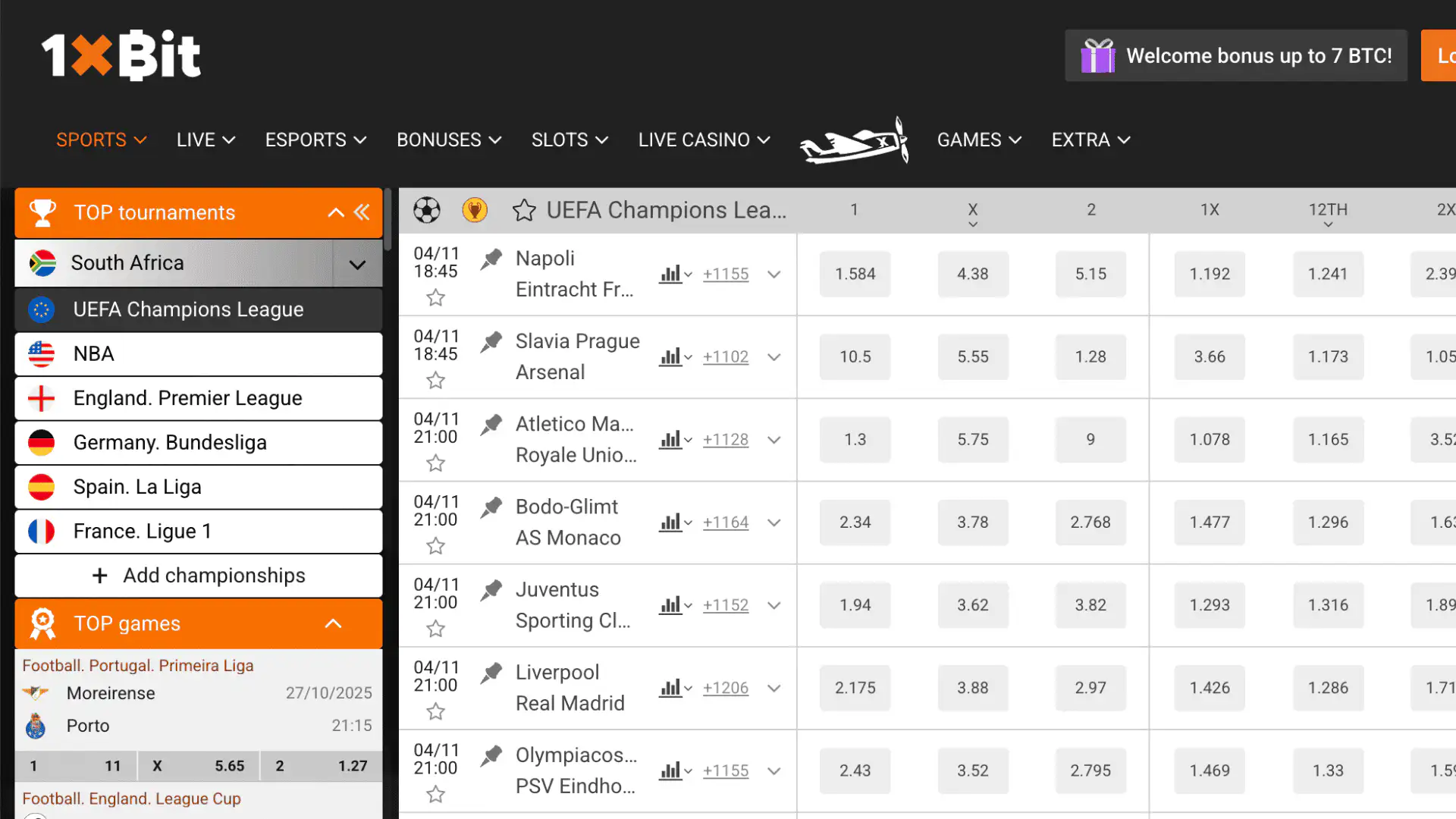
From a sports perspective, 1xBit is one of the most densely populated betting menus I have seen available to South Africans. Football sits at the centre, with coverage extending from the English Premier League and Champions League right down to reserve and youth competitions in smaller European and Asian nations. In match weeks, it is common to find several hundred football fixtures listed simultaneously, each with a deep lattice of markets ranging from 1X2 to player bookings, corners, and Asian handicaps.
For South African punters used to the local emphasis on football and rugby, the breadth can be jolting. The same interface that lists UEFA nights also surfaces Brazilian regional leagues, obscure African cups, and lower-tier Asian fixtures, many of them priced with surprisingly granular props. That structure extends beyond traditional favourites like soccer betting and rugby, into basketball, cricket, table tennis, volleyball, motorsport, and a very prominent esports hub, where the sheer volume of markets often outpaces what is available on domestic platforms by a comfortable margin.
The esports offering is particularly notable. Titles like CS:GO, Dota 2, and League of Legends get multi-layered market sets, including map winner, total rounds, kill handicaps, and specific player or team milestones. For anyone serious about esports betting SA, the market depth rivals that of specialised global books. There are also frequent live stats panels, which feed into fast-moving in-play odds that appeal to bettors who prefer to trade positions rather than place a single pre-match bet and hold.
Rugby and cricket receive solid coverage too, though the real differentiator for 1xBit sports is the inclusion of niche and emerging categories. You will often find markets on futsal, floorball, bandy, and even more obscure disciplines such as Gaelic sports and regional combat events. These are not always major handle drivers, but they speak to the platform’s ambition to be a one-stop destination for anyone who enjoys scanning the edges of the fixture list for mispriced odds.
In terms of structure, each event page can host hundreds of lines, from totals and alternative handicaps to period-specific bets. Asian lines and complex combination markets are common, which is excellent for advanced users but potentially overwhelming for newcomers. This is where personal experience matters: if you already understand Asian handicaps and total goals bands, the interface feels powerful; if not, it can look cluttered and intimidating until you narrow down the markets you actually use.
Live betting is where 1xBit’s infrastructure really shows. The in-play console feels engineered for volume, with constant price ticks and a layout that favours quick selection and confirmation. During busy European evenings, you can watch dozens of match tiles flicker as odds are recalculated based on score changes, possession swings, and incoming data feeds. As someone who tracks latency closely, I have found the refresh rate to be competitive with major international books.
The platform’s 1xbit live betting module supports an extensive range of in-play markets, from next goal and exact score bands to short windows like “result in the next 15 minutes.” For high-frequency bettors, this type of micro-market ecosystem behaves almost like a trading screen, where you can scale positions in and out rather than simply backing a single match outcome. It also integrates smoothly with in-play crypto betting, allowing you to keep staking as quickly as the blockchain confirms deposits and withdrawals to your internal wallet.
Streaming coverage is selective but meaningful. Popular football leagues, top-tier tennis tournaments, and certain basketball and esports events often come with embedded video feeds, provided your balance is funded and you have at least one bet related to the event. Even when a stream is not available, animated match trackers, shot maps, and possession graphs do a reasonable job of giving context to the shifting odds.
In my experience, the main constraint during live sessions is less about odds quality and more about user focus. With so many concurrent fixtures displayed, it is easy to spread your attention too thin. The multi-live view solves part of this by allowing you to pin a few key matches and monitor them more closely, but it still demands discipline. For South Africans who enjoy late-night European or American time zones, the combination of live betting and ready liquidity in crypto can be extremely tempting and needs to be managed carefully.
On the pricing side, 1xBit runs a relatively sharp model with noticeable margin variation depending on the sport, league, and time to kick-off. Major football competitions, popular esports events, and high-profile tennis tournaments tend to have tighter overrounds, particularly close to game time when liquidity peaks. Smaller leagues and niche sports often carry higher built-in margins, which is standard across the industry but more apparent on a platform that lists so many minor events.
I have compared 1xbit odds on key fixtures with a handful of other international operators on multiple occasions. For popular football matches, the platform frequently sits within a narrow band of the best prices on either side of the market, especially on core outcomes like 1X2 and main handicap lines. It does not always lead the board, but it rarely lags far behind. This behaviour is consistent with a competitive crypto sportsbook that pulls from strong data feeds and applies risk management tuned by years of global exposure, rather than treating South African traffic as a separate pricing pool like some onshore books do when calibrating rugby betting and other local favourites.
When you compare 1xBit to SA-licensed bookmakers, the contrast is clear. Many local operators run heavier margins on multis and popular weekend matches, trading away some value for simplicity and brand familiarity. By contrast, 1xBit behaves more like other sharp, globally oriented platforms such as Betandyou or 1xBet, where line movement is constant and liquidity is spread across a very wide event base.
For bettors who track expected value closely, this environment can be attractive. You can often find minor mispricings on secondary markets, particularly in esports and mid-tier football leagues where information asymmetry is higher. At the same time, it demands a more analytical approach: shopping lines, understanding margin structure, and accepting that price snapshots are temporary. Recreational users who only want a simple weekend acca may not fully leverage this advantage, but serious bettors will appreciate the underlying sharpness.

The bonus structure at 1xBit is unmistakably crypto-centric. Instead of the traditional single-match welcome offer you see on South African onshore books, the platform leans into multi-tier welcome packages, rolling promo codes, and ongoing cashback or accumulator boosts that scale as you wager more. The exact numbers can shift over time, but the underlying logic stays similar: reward consistent activity and higher volumes rather than once-off deposits.
When assessing offers, the first thing I check is the effective wagering requirement. Crypto bonuses tend to advertise big headline numbers, but smart bettors look closely at the turnover multiple, qualifying markets, and minimum odds. On 1xBit, these rules are written with a crypto-native mentality, expecting users to understand that bonuses are denominated and settled in digital assets rather than in rand, which has a direct impact on how you calculate potential value. That same dynamic applies at other operators in this space, including 1Xbit South Africa: Crypto-focused, bonuses vary widely; wagering usually 5x or higher (specific South Africa terms unclear), where conditions often mirror the fast-moving nature of blockchain transactions as much as they mirror traditional sportsbook promos used for UFC betting or mainstream football offers.
Beyond the headline welcome offer, 1xbit bonus mechanics include accumulator boosts where your potential payout increases with the number of selections, periodic free bet-style promos tied to specific tournaments, and themed campaigns around major events such as World Cups or large esports championships. There is also a loyalty framework that tracks your activity through experience points (XP), unlocking higher reward tiers, better cashback percentages, or exclusive promos. In my experience, that XP system feels more like a gaming progression ladder than a traditional VIP scheme.
One subtle but important feature is how bonus balances interact with your main crypto wallet. Some offers lock part of your stake in a separate balance that only becomes withdrawable once turnover conditions are met, while others simply add extra funds that you can stake with immediately but must roll over multiple times. Understanding which model applies to each promotion is crucial, because it determines how flexible your bankroll remains during heavy betting periods.
For South Africans already familiar with crypto price swings, the key consideration is that the value of your bonus can change with the market. If you receive a bonus in BTC and the price moves meaningfully during your wagering period, your effective gain or loss may differ from what you initially calculated in ZAR terms. That volatility cuts both ways, but it is part of the deal when operating purely on-chain. Careful staking, shorter wagering windows, and choosing relatively stable coins where available can help mitigate some of that exposure.
On 1xBit, so-called free bets and other promotional credits follow a predictable but nuanced structure. You typically receive a token or bonus balance that must be staked on events meeting certain minimum odds, with any net winnings transferred to your main wallet once the bet settles. The initial stake often does not return with the profit, which is a standard mechanic across many sportsbooks but worth reminding yourself of when sizing your positions.
The critical piece with any 1xbit free bet is the wagering logic in a volatile currency environment. Turnover requirements may demand multiple times the bonus amount in crypto stakes before you can withdraw profits, and because your bankroll is sitting in assets like BTC, ETH, or USDT, the fiat equivalent can shift as markets move. This is where understanding basic crypto bonus rules matters as much as understanding the sports you are betting on.
Expiry windows also need close attention. Some promotions require you to use the free bet within a few days, while others give you longer to complete the turnover. Given that blockchain confirmations are generally quick, the limiting factor is usually your own betting schedule rather than transaction delays, but I have seen bettors simply forget about a bonus until it lapses, especially when juggling multiple coins in the same account.
Practically, I recommend treating bonuses as an enhancement to a bankroll you would have used anyway, not as a separate speculative pot. Aligning promo use with your existing strategy, for example, focusing free bets on markets you already understand well, tends to produce better outcomes than chasing exotic accumulators purely because the stake is promotional.
Banking on 1xBit is entirely crypto-based, which dramatically changes the user journey compared to South African bookmakers tied to local banks and card processors. When you open the cashier, you are greeted with a long list of cryptocurrencies rather than the familiar Visa, EFT, or instant EFT logos. That list typically includes 40+ coins, such as BTC, ETH, USDT, LTC, XRP, TRX, BNB, DOGE, and several others that cover a mix of blue-chip assets and popular altcoins.
From a functional perspective, each coin operates as a separate deposit and withdrawal rail, with its own address and network fee profile. The platform generates wallet addresses per currency, and you send funds from your external wallet or exchange account to those addresses. Once confirmed on-chain, anything from seconds on faster networks to longer on congested chains, your balance updates almost instantly on the site, ready for use on football, cricket, or tennis betting markets that share the same internal accounting engine regardless of which crypto asset you used for funding.
The absence of fiat means there are no direct ZAR conversions, no card charge descriptors, and no bank statements reflecting gambling-related transactions. For many crypto betting South Africa users, this is precisely the appeal: the financial footprint is contained within their wallets and exchanges, and movement between coins and rand happens outside the sportsbook, at venues of their choosing. It also means that foreign exchange fees and card declines are simply not part of the equation.
However, crypto deposits require more technical care. Copying the correct address, picking the right network (for example, distinguishing between ERC-20 and TRC-20 versions of a stablecoin), and understanding network fees are all essential habits. Sending funds on the wrong chain or to an incorrect address is rarely reversible, and while 1xBit’s support can occasionally help with misdirected internal transfers, they cannot restore transactions that never reach their controlled wallets.
On the upside, once you are comfortable with the mechanics, crypto deposits become extremely efficient. There are no intermediary bank holds, no card verification processes, and no waiting for business hours. You can top up in the middle of the night, during a live session, or while travelling, as long as you have access to your wallet. For South Africans who routinely deal with cross-border limits and compliance questions when using international platforms, this freedom is often the main draw of 1xbit crypto deposits and similar on-chain ecosystems.
Withdrawals at 1xBit follow the same crypto-only philosophy as deposits, but with a few operational twists that matter in real use. When you request a payout, you specify the coin, the network, and the destination address. Assuming no account-specific review flags, the system typically releases funds quickly, leaving the rest of the journey to the underlying blockchain. On relatively uncongested networks, the time from request to on-chain confirmation can be minutes rather than hours or days.
In my own tests, 1xbit withdrawals have displayed consistently fast processing on mainstream assets like BTC, ETH, and USDT, with occasional delays during peak event periods or when manual checks are triggered. Network fees are either passed through to the user or accounted for in the payout amount, depending on the coin and current fee levels. This is where understanding the fee economics of your chosen coin helps, especially if you withdraw frequently rather than in larger, less frequent batches, which is often the recommended pattern for crypto payouts SA users.
One notable benefit for South Africans is the absence of ZAR-specific delays. There is no need to wait for bank clearing cycles, no risk of an international transfer being queried for additional paperwork, and no intermediary correspondent banks to clip fees. Once the funds hit your wallet, any conversion to rand happens on your own timing, through your chosen exchange or peer-to-peer venue.
That said, users should remember that crypto transfers are effectively final once confirmed on-chain. Double-checking addresses, test-sending small amounts when dealing with a new wallet, and keeping a record of transaction hashes are sensible practices. These habits are not unique to 1xBit but are part of operating safely in any crypto-native betting or trading environment.
On mobile, 1xBit prioritises functionality over minimalism. The browser version is responsive and surprisingly smooth given the density of markets, and there is also an Android app for users who prefer a dedicated icon and slightly faster load times. In both cases, the design philosophy is clear: expose as many events and lines as possible without forcing excessive navigation, even if that means the screen looks busier than the typical South African betting app.
The main sports menu collapses into a compact sidebar, while the central pane is dominated by live events and upcoming highlights. Once you tap into a fixture, markets stack vertically, grouped by type, allowing quick scrolling rather than deep menu drilling. Bettors who enjoy fast live action often appreciate this structure, as it makes it easier to spot opportunities and adjust positions. The betslip anchors to the bottom of the screen, expanding into a full view when needed, and handles single, multi, and system bets with similar ease to more traditional crypto betting app interfaces designed for day traders.
From a usability standpoint, the learning curve is real but manageable. New users can feel overwhelmed by the sheer volume of numbers and abbreviations until they personalise their view. The ability to mark favourite leagues and teams, filter by sport, and save preferred bet types goes a long way towards turning the initial firehose into something more digestible. I usually advise putting in a few dry-run sessions, browsing markets without staking, to get used to the flow.
Performance-wise, the platform handles live updates competently on mobile data, though older devices may feel some strain when multiple multi-live views and live stats widgets are open simultaneously. Still, considering the complexity under the hood, constant odds updates, streaming integration, and wallet balance sync, the overall responsiveness is impressive and well suited to South Africans who mostly access betting sites on smartphones rather than desktops.
Ultimately, 1xbit mobile usage rewards those who invest a little time in customising their layout and understanding the shorthand of markets. For bettors who already run other trading or charting apps on their phones, the density will feel familiar; for casual weekend punters, it may feel like more power than they truly require.
The desktop interface of 1xBit is unapologetically feature-rich. At first glance, it resembles a professional trading terminal more than a simple bookmaker homepage. Columns of events, sidebars filled with quick links, and multiple filtering layers are all visible from the moment you log in, which can be both empowering and intimidating depending on your experience level.
Navigation follows the classic three-column pattern: sports and competitions on the left, event lists in the middle, and additional widgets or the betslip on the right. This structure allows you to keep several layers of information visible simultaneously, live scores, upcoming fixtures, and your active bets, without constant tab switching. For users focused on 1xbit user experience in the context of advanced play, this dense layout makes it easier to monitor multiple markets while adjusting stake sizes or tracking cached lines, even if it feels busier than the streamlined layouts favoured by some betting interface SA operators more focused on casual users.
One standout component is the multi-live view. You can select several events and stack them vertically in a single screen, each with its own mini-market set and live stats. For in-play specialists, this is a powerful tool; it allows side-by-side price comparison across matches and quick reaction to swings, particularly in football and basketball where game flow can change rapidly. Combined with a fast betslip, it turns the interface into a responsive, almost exchange-like environment.
Customisation features help tame the complexity. You can change odds formats, pin favourite competitions, and adjust how markets are grouped and displayed. In my experience, once you invest an hour or so into tuning these settings, the platform becomes considerably more intuitive. The risk is that users who do not make those adjustments may feel overwhelmed and miss opportunities simply because key markets are buried among options they never use.
Overall, the UI design is clearly aimed at serious bettors who value information density over glossy minimalism. It is not the cleanest or most beginner-friendly interface in the South African market, but for users who want maximum control and visibility, it delivers a strong, if intense, experience.
Beyond standard pre-match and live markets, 1xBit packs in a wide array of advanced tools that elevate it from a traditional sportsbook to something closer to a multi-product betting platform. These features are not always front and centre, but once discovered, they become central to how many seasoned users interact with the site day to day.
The most widely used tool is cash out, which allows you to settle a bet early at a dynamically calculated price. This is particularly valuable during volatile matches or multi-leg accumulators where you may want to lock in profit or trim risk before the final whistle. The cash out crypto engine recalculates value in real time, taking into account current odds, your initial stake, and the remaining uncertainty. It behaves similarly to cash out features on fiat books, but with the added speed and flexibility of on-chain bankroll management, especially when compared to more static products built for traditional soccer betting audiences.
Another notable component is the bet constructor, a tool that resembles a bet builder. It lets you combine multiple selections within the same match, such as result, goals, and specific player stats, into a single custom ticket, with the platform recalculating combined odds as you tweak parameters. For analytical bettors who model specific scenarios, this offers a way to express nuanced views that standard markets do not capture, all under the umbrella of 1xbit features tailored toward flexibility.
Esports fans also benefit from specialised tools: real-time stat overlays, map-level breakdowns, and integrated streams for major tournaments. These elements may look cosmetic at first, but they materially improve decision-making in fast series where momentum can flip quickly. Having kill counts, economy graphs, and objective control displayed directly above the betting markets is far more efficient than juggling separate stat sites and streams.
Lastly, the platform integrates a casino section with slots, live dealers, and other RNG-based products, accessible from the same wallet. While this review focuses mainly on sports, the unified wallet and interface mean you can move between products without transferring funds. For some, that is a convenience; for others, it is a temptation. In my view, the key is to set clear personal boundaries and treat sports betting and casino play as distinct activities, even if the software blends them together.
Customer support on 1xBit operates through a mix of live chat, ticket forms, and email channels, all accessible from within the interface. In my interactions, response times on live chat have ranged from almost immediate to several minutes, depending on traffic and time of day. For simple queries, navigation questions, basic bonus clarifications, or status checks on transactions, agents usually provide concise, scripted answers that are sufficient to resolve routine issues.
More complex topics, such as disputed settlements, delayed withdrawals, or edge-case technical problems, often require escalation to back-office teams. In these situations, users typically receive a ticket number and must wait for email follow-up. This is where the offshore nature of a customer service crypto sportsbook can become apparent: time zones, workload spikes, and internal approval flows can all extend resolution times beyond what local players might expect from domestic operators, especially those with call centres dedicated to South African markets like mainstream UFC betting brands.
Reliability-wise, the site’s core uptime has been solid in my observation. The main betting engine, wallet balances, and odds feeds generally stay responsive even during major global events. Occasional maintenance windows and brief lags during peak load are inevitable on any large platform, but there is no persistent pattern of outages that would raise red flags.
The trade-off with an offshore, crypto-only book is that you do not have the same escalation paths you would with a strictly regulated local bookmaker. There is no South African office to visit, no domestic ombudsman specifically dedicated to mediating 1xBit disputes. That does not mean users are left without recourse, but it does place a stronger emphasis on keeping personal records, screenshots of bets, transaction hashes, and chat transcripts, to present a clear case if things go sideways.
In short, the support infrastructure is functional and generally responsive, but users should approach it with realistic expectations: efficient for everyday questions, more variable when deeper investigation is required, and ultimately shaped by the operational rhythms of an international, crypto-led betting platform rather than a locally anchored one.
The security model at 1xBit is built on the interplay between blockchain transactions, encrypted web traffic, and a deliberately lean data footprint per user. From the moment you register, the system encourages anonymity: you can create an account without immediately providing personal identifiers, and you can fund it purely with crypto, leaving no direct link to local bank accounts or cards. For many, this is the core appeal of anonymous betting South Africa users seek when they step outside mainstream platforms.
At the same time, this structure changes the risk profile. Because there is little personal data attached to your account, traditional recovery methods are limited. Losing your login credentials, disabling two-factor authentication without backups, or misplacing your account ID can be more consequential than on a site where your email and ID document are on file. 1xbit safe usage, in this context, depends as much on your own operational hygiene, password managers, secure storage of credentials, and careful control of device access, as it does on the platform’s own encryption and database security, which is reinforced by the same SSL standards widely used across financial services and other betting environments.
On the transactional side, blockchain-based deposits and withdrawals provide transparency in the form of public ledgers. You can independently verify that funds left your external wallet and reached a 1xBit address, then later check that outgoing withdrawals landed at your chosen destination. This is a different model from fiat systems, where much of the flow is opaque to end users. However, it also means transfers are effectively irreversible once confirmed, raising the stakes on every address and network choice you make when moving funds on or off the platform that might otherwise be used for mainstream tennis betting or other sports.
From a broader South African perspective, using an offshore, crypto-only sportsbook also involves understanding legal grey zones and practical limitations. While many users access such platforms without issues, the absence of local licensing means there is no domestic regulator specifically tasked with supervising 1xBit. That does not automatically equate to unreliability, but it does change where accountability lies and how disputes might be handled compared to local operators.
Ultimately, safety on 1xBit is a shared responsibility. The platform provides strong technical foundations, encryption, a hardened wallet infrastructure, and account-level protections like two-factor authentication, but users must bring their own discipline in terms of credentials, device security, and bankroll management. For South Africans who are already accustomed to securing crypto assets independently, this will feel familiar; for those new to both crypto and offshore betting, the learning curve deserves careful, step-by-step navigation.
Positioning 1xBit within the South African betting landscape requires a direct comparison with both domestic bookmakers and other international crypto operators. On the local side, brands like Betway, Hollywoodbets, and Gbets offer familiar interfaces, ZAR accounts, and banking rails tied to cards, EFT, and instant EFT solutions. They are regulated within South Africa and design their products primarily for mainstream users who want straightforward accumulators on weekend fixtures.
By contrast, 1xBit targets a more specialised cohort: crypto-savvy bettors who value anonymity, multi-currency wallets, and high event density. It shares this niche with international names like Stake and BC.Game, as well as non-crypto giants such as 1xBet, which offers a similar depth of markets but retains fiat support. When you look at 1xbit vs competitors SA options, the core differentiators become clear: instead of localised bonuses and bank-linked cashouts, you get a global, on-chain architecture that behaves consistently across sports, including markets as diverse as football, cricket, or even rugby betting when those fixtures are listed alongside international leagues.
On strengths, 1xBit stands out with its massive market selection, covering everything from major football and esports competitions to low-tier and niche sports. Its crypto banking layer offers rapid deposits and withdrawals without interacting directly with South African banks, which can be a major advantage for users comfortable managing their own wallets. The anonymity-first registration flow is another distinctive feature, sharply different from the KYC-heavy onboarding seen on domestic sites.
On the flip side, the absence of ZAR support is a clear friction point for many local bettors. You must be willing to convert between rand and crypto externally, manage volatility risk, and accept that your bankroll will be denominated in assets whose fiat value can change daily. Additionally, the offshore status means you do not enjoy the same formal recourse channels you would with a locally licensed operator, and the interface is less tailored to South African sporting priorities like local league football and provincial rugby.
In practical terms, I often see 1xBit serving as a secondary or specialist account for South African bettors, complementing one or more local books. Users may keep ZAR-based wagering on domestic operators for simplicity, while turning to 1xBit when they want deeper markets, sharper odds on global events, or the benefits of full crypto banking. That hybrid approach seems to capture the best of both ecosystems while mitigating some of the individual drawbacks.

As a whole, 1xbit South Africa presents a compelling proposition for a specific type of bettor: someone comfortable with crypto, appreciative of anonymity, and interested in a deep, globally oriented market offering. It does not try to mirror the user experience of local, ZAR-based bookmakers; instead, it doubles down on its strengths as a crypto-only, offshore sportsbook with a trading-style interface.
The advantages are clear: rapid on-chain deposits and withdrawals, extensive coverage across mainstream and niche sports, competitive odds on major events, and advanced tools like cash out, bet constructor, and multi-live views. At the same time, users must accept the realities of volatility, the need for external ZAR–crypto conversion, and an oversight framework rooted outside South Africa.
In my experience, 1xBit works best either as a primary home for highly engaged, crypto-native bettors or as a powerful secondary account alongside one or two local books. For South Africans who fit that profile, and who are willing to invest in good security practices and disciplined bankroll management, it offers a rich, flexible environment that is difficult to replicate within the constraints of traditional, rand-denominated operators.e suggested improvement here would be to make their site slightly minimalistic. But overall, they are doing good.