Campeonbet South Africa delivers international sports betting markets with competitive odds and a streamlined platform for local bettors.



 Detailed match statistics help bettors make informed choicesCash-out feature allows partial or full bet controlResponsive customer support via live chat and Telegram
 Account verification required even for small withdrawals


















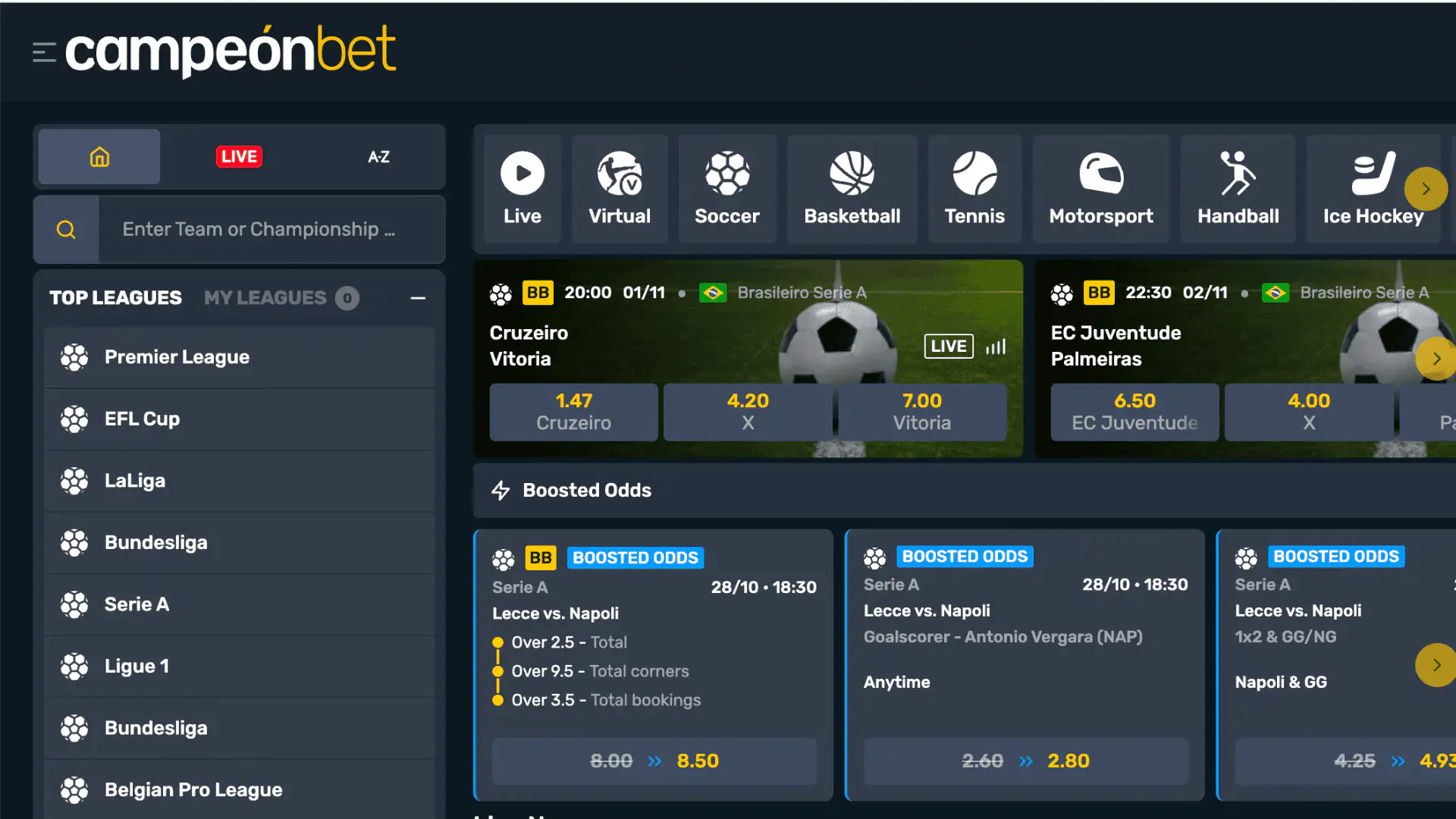
Campeonbet South Africa sits in that space where ambitious international sportsbooks meet increasingly sophisticated local punters. For South Africans who feel boxed in by familiar brands, this offshore bookmaker offers a hybrid of full-scale sportsbook and casino, wrapped in a modern platform that feels more European than local. In my experience, that combination can be attractive for bettors who want broader markets and more flexible payment rails than they usually find on home soil.
Accessing Campeonbet South Africa from within the country is technically straightforward, but it carries the usual caveats that apply to any offshore operator. The site is reachable via standard browsers, and the interface detects your region well enough to suggest appropriate languages and default odds formats. In my experience, the initial impression is that of a typical international sportsbook hub, with a prominent “Join” button and an immediate invitation to explore the lobby before committing to registration.
Creating a Campeonbet SA account follows a familiar pattern: basic personal data, contact details, and then a second phase where you submit verification documents and, for some payment flows, interact indirectly with tools similar to those used by Citadel to confirm banking and identity details in other financial contexts. This two‑phase approach may feel slightly formal compared with quick sign‑ups on local sites, but it reinforces structured KYC flows that most serious bettors have come to expect when dealing with multi‑currency wallets and higher transaction ceilings.
Because Campeonbet is effectively an offshore sportsbook SA users can reach but not regulate locally, registration defaults to foreign-currency balances by design. Bettors can generally choose among major options such as EUR or USD, and sometimes link a separate crypto balance for digital coins. This means that every deposit from a ZAR-based card or wallet will likely involve conversion at the operator’s or payment processor’s rate, introducing another small but ongoing cost factor that value-conscious punters should monitor closely.
On the technical side, I have seen the platform handle location checks and KYC uploads with relatively low latency, provided that documents are clear and match the registration details. Still, offshore operators tend to apply stricter manual review if a user’s transaction volume spikes quickly, or if they frequently switch devices and IP ranges. For South African bettors used to fast local onboarding, these additional checks can feel intrusive, but they are part of the trade-off for accessing a more global ecosystem of odds, markets, and payment methods.
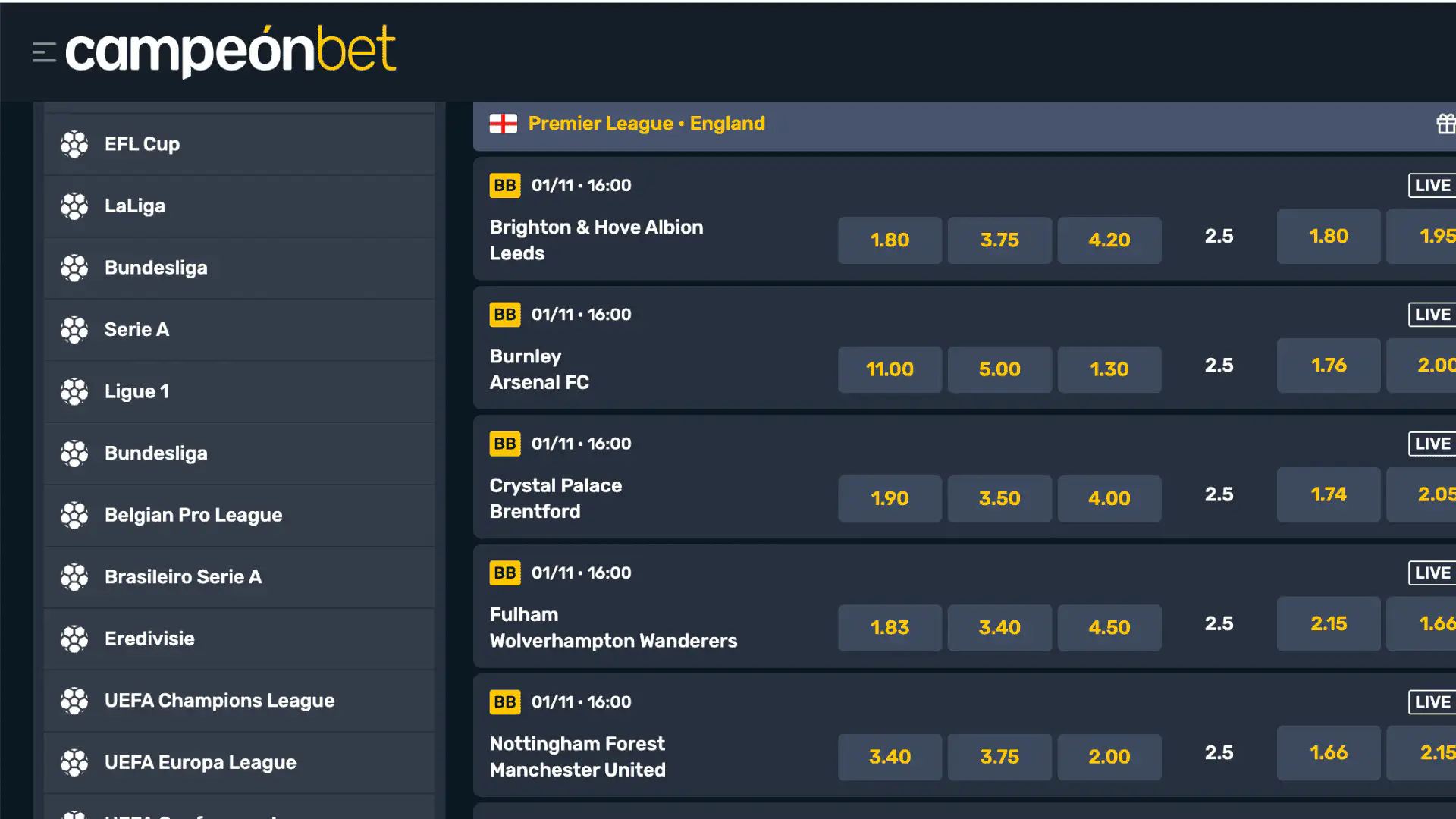
The sports catalogue at Campeonbet South Africa reads like a global fixture grid rather than a locally curated offer. Soccer dominates the landing view, with top European leagues, continental competitions, and major international tournaments stacked alongside South African domestic fixtures. For regulars in soccer betting SA markets, the depth is immediately visible: full-time results, Asian handicaps, totals, corners, cards, player props, and a strong array of multi-leg combinations.
Beyond the obvious big leagues, seasoned users looking for broader Campeonbet sports options will find respectable coverage for rugby union and league, cricket series involving South Africa and other full members, plus basketball and tennis tours all year round. In this broader environment, where payment and data flows increasingly resemble the flexibility offered by voucher and card systems such as Blu Voucher, the platform’s back-end clearly leans on shared international feeds to populate odds and markets in near real time, maintaining parity with European-facing competitors.
One area where Campeonbet distinguishes itself from many purely domestic books is esports betting SA enthusiasts will appreciate. Titles like CS:GO, League of Legends, Dota 2 and various arena shooters appear with pre-match and live markets, often supported by deeper props such as map handicaps, kill lines, and race-to objectives. In my experience, esports pricing can swing faster than traditional sports, and the site’s odds-refresh engine is fast enough to keep serious bettors engaged rather than frustrated by constant suspensions.
For niche tastes, the long tail is impressive: American football, baseball, ice hockey, handball, volleyball, and even smaller tours and regional competitions appear regularly. Accumulator builders allow you to combine these from different codes, which suits bettors who enjoy cross-sport slips that local books often under-serve. The trade-off is complexity; with so many leagues, filters, and bet types visible at once, new users may need time to learn where to find their favourite competitions and how to avoid overloading their slips with unfamiliar markets.
The live environment at Campeonbet South Africa is designed for constant engagement, with multiple fixtures ticking across soccer, tennis, basketball and occasionally cricket at any given moment. Once you click into a match centre, odds panels reshuffle every few seconds, and you can watch lines move as momentum shifts or as the clock winds down. In my experience, this dynamic layout is particularly effective during busy football weekends, when dozens of games across Europe and South America are in play simultaneously.
Campeonbet live betting is supported by an interface that prioritizes quick actions: the bet slip sits sticky on the side or bottom (depending on your screen), and stake adjustment fields respond with minimal delay. The in-play SA market selection covers mainstream choices such as next goal, total goals, match winner, and handicaps, but you will also find period-based bets and occasional player specials for top-tier fixtures. Compared with some local operators that throttle live markets, Campeonbet tends to keep more options available deeper into the match, even if odds occasionally suspend briefly during key incidents.
One technical detail I have noticed is how the in-play engine handles latency. Odds updates are frequent, but the system usually locks the price the moment you confirm the slip, followed by a short “waiting” message while it checks the backend feed. Rejected bets are relatively rare unless you try to place them during an obvious scoring opportunity or breakaway, which suggests that the internal risk models are tuned to allow active betting without being overly conservative.
For tennis and basketball, the platform surfaces live scoreboards with set or quarter breakdowns and possession indicators. Although there is not always embedded streaming, the data visualisations are detailed enough to support tactical in-play decisions. Bettors who prefer to watch on TV or separate streams while using Campeonbet purely as a transactional layer will find the live section responsive, with enough market diversity to back up their read of the game in real time.
From a pricing perspective, Campeonbet South Africa positions itself closer to mid-tier European books than to typical domestic operators. When I have compared headline soccer markets across popular leagues, the margins often sit slightly below what you see at many local sites, particularly on match-winner lines. That does not automatically make it the best price on every event, but for bettors who shop around, Campeonbet can frequently deliver the extra half‑point or fraction that adds up across a season.
The appeal of Campeonbet odds extends beyond pre-match soccer into tennis and basketball, where set and quarter handicaps are often aggressively priced. This is especially relevant for sharp punters who understand how small variations in spread or total lines translate into long-term edge, comparable to how slight differences in transaction fees on digital assets such as Bitcoin can compound over repeated transfers in a high-volume trading or payments environment. In practice, a consistent 0.05 or 0.10 push in your favour on popular lines can materially shift your bottom line over hundreds of bets.
Accumulator fans will notice that multi-leg pricing maintains decent generosity even as the slip grows. While some bookmakers quietly pad margins as you add more selections, Campeonbet often leaves the underlying odds intact and then overlays occasional boosts or insurance offers. In my experience, this structure suits recreational bettors who enjoy bigger tickets without necessarily diving deep into advanced modelling, while still being interesting enough for analytically minded players who track implied margins closely.
Still, value is not uniform across the board. Secondary markets such as obscure leagues, player specials, or exotic props sometimes carry higher margins, a pattern I have seen across almost every offshore platform. For serious bettors, the best approach is selective engagement: focus on core competitions where liquidity is strongest and prices are sharpest, and treat the more colourful props as occasional side bets rather than daily staples. Used this way, Campeonbet’s odds profile can complement rather than replace existing local accounts, offering an additional lane for line shopping when numbers diverge.
Promotional structures at Campeonbet South Africa follow the familiar blueprint of offshore sportsbooks, starting with a substantial welcome package and then shifting into ongoing offers that mix sportsbook and casino value. New users are typically greeted with a first-deposit bonus calculated as a percentage match up to a fixed ceiling, sometimes split between sports and casino wallets. In my experience, this arrangement encourages exploration of both verticals, though it also means you need to track wagering requirements across separate balances.
For bettors interested in a Campeonbet bonus, the most important step is to read the fine print before committing, in much the same way that careful players examine transaction terms when using voucher-based rails like the American Express ecosystem in other online contexts, paying close attention to settlement times, conversion rules, and applicable fees. Welcome offers often come with minimum odds thresholds, excluded markets, and rollover multipliers that significantly affect the real value of the promotion once you map it against your actual betting style and stake size.
Regular Campeonbet promotions SA users encounter include reload bonuses on specified days, odds boosts on selected accumulators, and occasional cashback offers tied either to net losses or specific event categories. There are also cross-product campaigns that reward sportsbook turnover with free spins or casino credit, a model clearly designed to encourage movement between verticals. I have seen seasoned bettors treat these extras as a secondary layer of value rather than a primary strategy driver, which is usually the healthiest way to view promotions that carry conditions.
One nuance specific to Campeonbet South Africa is that available public information on exact local bonus structures remains limited. The note that “Campeonbet South Africa: Limited info available; no clear bonus/wagering details for South Africa” reflects a broader reality: this is an offshore brand whose promotional engine is tuned at a global level and then selectively adjusted by region. As a result, South African users may occasionally see promotions that resemble those offered elsewhere but with subtle differences in eligible currencies, payment methods, or jurisdictional restrictions, making periodic re-checks of terms essential.
Free bets on Campeonbet South Africa tend to appear as part of targeted campaigns rather than as constant evergreen offers. They may be linked to specific leagues, accumulator challenges, or reload promotions where meeting a turnover threshold unlocks a token stake. In my experience, these free bets usually arrive with a short validity window, so active users who log in frequently benefit more than occasional visitors who might miss the opportunity entirely.
When a Campeonbet free bet SA token is credited, it typically requires placement at or above specified minimum odds, which are often set to discourage ultra-short favourites. Winnings derived from the token may be credited net of the stake and then subject to a modest rollover before withdrawal. That structure is standard in the offshore market but emphasises the importance of aligning promotion use with your underlying approach: free bets are most powerful when deployed on selections you would seriously consider anyway, not on random long shots played solely because the token exists.
To maximise value, I suggest treating free bets as a separate category in your tracking, logging both the notional value and resulting returns. Over time, this gives you a clearer sense of whether they meaningfully improve your performance or largely cancel out through conditions and variance. Because Campeonbet’s promotions can change quickly, maintaining a personal record is often more reliable than relying on memory or scattered email notices.
Overall, free bets at Campeonbet function as useful add-ons rather than core pillars of the product. They can soften variance, especially during busy football weeks or tournament periods, but they do not override the fundamentals of odds quality, bankroll management, and market selection. For South African punters who already approach betting with a structured plan, these tokens are best seen as tactical tools to be used intentionally rather than as reasons to chase extra volume.
Funding a Campeonbet South Africa wallet reflects the platform’s international roots, with a mix of card options, e-wallets, and crypto channels typically on offer. While the exact menu visible in your cashier may depend on region, South African users generally encounter major card brands, popular digital wallets, and at least one or two crypto alternatives. In my experience, the cashier layout is reasonably clear, with indicative limits and processing notes attached to each method, though you still need to factor in the additional step of currency conversion from ZAR to a supported account currency.
For those exploring Campeonbet deposits beyond cards, the crypto option stands out, particularly where supported coins resemble the decentralised flows of assets like 1ForYou voucher systems in terms of user-driven control, while differing fundamentally in blockchain-based settlement and volatility dynamics affecting account balances. Crypto deposits typically land after a small number of network confirmations, and the sportsbook credits them at an internal exchange rate into your chosen account currency, which means your exposure to coin price movements may extend beyond the deposit moment if you leave value parked on-chain.
E-wallets remain a popular choice for South African bettors used to moving money between multiple platforms. Processing is usually instant, and the ability to consolidate wins and redeploy them to different operators without re-entering card details appeals to more security-conscious users. However, not all wallets are equally friendly to ZAR; some require you to hold balances in major foreign currencies, increasing your exposure to forex shifts. In my experience, users who maintain a modest float rather than large static balances tend to manage this risk more comfortably.
Traditional bank transfer or EFT options sometimes appear in the cashier, but they often involve longer settlement windows and more complex reference procedures. Because Campeonbet is offshore, bank flows may route through foreign intermediaries, increasing both time and potential fees. For that reason, many South African punters reserve bank methods for larger, less frequent transactions, such as initial seeding of a bankroll, while relying on faster instruments like cards, e-wallets, or crypto for day-to-day top-ups and adjustments.
On the withdrawal side, Campeonbet South Africa generally mirrors the deposit logic: where a method supports both directions, the platform prefers to send funds back along the same rail, particularly for cards and e-wallets. First-time withdrawals usually trigger a full KYC review, including document verification and sometimes proof of payment method ownership. In my experience, clearing that initial hurdle smoothly depends heavily on having submitted crisp, up-to-date documents during the registration or early deposit phase.
For many users concerned with Campeonbet withdrawals, e-wallets and crypto channels tend to deliver the fastest turnaround once the internal approval is complete, with funds often arriving the same day or within 24 hours, comparable to efficient digital settlements in broader payout times SA financial ecosystems dealing with foreign intermediaries. Card withdrawals may take longer as they travel through multiple banking layers, frequently stretching to several business days before the credit appears in your account.
Bank transfers, especially when cross-border, sit at the slower end of the spectrum. Here, delays can stem not only from Campeonbet’s processing cycle but also from correspondent banks and local clearing rules. Fees may also be higher, eating into the net amount received. Given these realities, I have seen experienced bettors maintain a clear hierarchy of withdrawal choices: fast digital rails for regular cashouts and occasional bank transfers only when necessary for larger sums or personal accounting reasons.
Regardless of method, the most common friction I have observed arises when users attempt to withdraw before meeting wagering conditions linked to bonuses or when deposit and withdrawal rails do not align. To avoid such issues, it is worth aligning your payments strategy with your promotional use and keeping a simple log of which methods funded each account cycle. This reduces back-and-forth with support and helps ensure that successful withdrawals function as a routine part of your betting rhythm rather than a source of anxiety.
Using Campeonbet South Africa on a smartphone or tablet feels noticeably different from navigating it on a full desktop screen, but in a way that suits live and casual betting. The mobile browser version loads into a compact layout with collapsible menus for sports and leagues, a persistent bottom navigation bar, and a simplified bet slip pull-out. In my experience, pages render quickly on stable mobile data, though live odds-heavy sections can occasionally require an extra second or two when multiple events are updating simultaneously.
The overall Campeonbet mobile experience aligns with the expectations of modern mobile betting SA users who are comfortable switching between apps and browser tabs to follow scores, watch streams, or manage e-wallets, almost as seamlessly as they would redeem digital value through systems conceptually similar to a Citadel style single‑sign‑on in other financial platforms, but applied here through quick authentication and saved device preferences. The site remembers core settings like odds format and preferred sports, allowing a relatively frictionless re-entry each time you log back in.
One subtle but important element is how the mobile interface handles multi-leg slips. The bet slip overlay allows quick stake editing for individual legs as well as the total accumulator, which I have found crucial during busy live sessions where odds are shifting rapidly. Scrolling remains smooth even with double-digit selections, though on smaller screens it pays to be disciplined about the number of markets you include if you want to avoid mis-taps or accidental changes.
Visually, the site leans towards a dark theme with accent colours drawing attention to active markets and promotional banners. While this aesthetic reduces eye strain in low light, heavy use of banners can sometimes crowd the top of the screen until you scroll past them. For South African punters who spend significant time on their phones following weekend fixtures, the balance between density and clarity is acceptable but may take a few sessions to personalise via favourites, filters, and the hiding of less relevant sports.
Viewed on a larger screen, the Campeonbet South Africa interface reveals its full architecture: a left-hand column for sports and major leagues, a central pane for events and markets, and a right-hand area for the bet slip and promotional widgets. This three-column structure is standard for international books but can feel intense for newcomers, as it places a huge volume of information just one or two clicks away. In my experience, users who take time to configure favourites and toggle filters early enjoy smoother navigation in the long run.
The broader Campeonbet interface philosophy appears to prioritise breadth and speed over radical simplicity, somewhat like high-traffic transactional dashboards used in sectors where tools such as Blu Voucher support multiple concurrent flows of payments, redemptions, and user actions across shared UI components. Search fields and category filters assist in slicing through the noise, while quick links surface popular competitions and upcoming highlights. Once you know where your preferred leagues sit, the click path becomes short enough to feel efficient even on busy match days.
Where the platform occasionally stumbles is in information density. Match centres can pack in many markets, and toggling between main lines, handicaps, and specials sometimes requires more scrolling than ideal, especially on mid-sized laptops. I have also noticed that for very niche sports, some submenus are not as intuitively labelled as core ones, leading to occasional misclicks. These are not deal-breakers, but they underline that Campeonbet is better suited to medium-to-advanced bettors willing to invest time into understanding the layout.
On the positive side, usability is reinforced by consistent button styling, clear odds formatting, and responsive bet slip confirmations. Hover cues and simple colour changes indicate selections and odds movements, which helps reduce accidental selections or stake mis-entries. For South African punters comfortable with multitab browsing and data-heavy interfaces, the platform delivers a robust environment where the main limitation is cognitive load rather than technical friction.
Beyond core pre-match and live betting, Campeonbet South Africa offers a collection of features designed to give bettors more control over how and when they settle their positions. Cash Out and, on selected markets, Partial Cash Out functionality are central here, allowing you to close all or part of a bet before the underlying events finish. In my experience, this is particularly useful during accumulator runs where a final leg remains and you wish to lock in a portion of gains while still leaving some upside on the table.
The suite of Campeonbet features often includes bet builders or custom multi-bet tools, letting you combine correlated selections within a single fixture, similar to how flexible digital finance products can layer multiple actions over one underlying asset such as Bitcoin without forcing you to juggle separate interfaces or accounts. These builders surface granular events like goals, cards, corners, and player stats, giving analytically minded users ample room to map their read of a game into a structured wager while tracking implied correlations.
Accumulator betting SA enthusiasts will also notice periodic promotions tied specifically to multi-leg slips: boosted payouts if all legs win, insurance if one selection fails, or targeted odds increases on popular weekend combinations. In my experience, these offers are best approached with a clear stake strategy; they can meaningfully raise your effective price when used sparingly on strong, well-researched tickets, but they do not fundamentally change the risk profile of long multiplication chains where a single unexpected result can derail the entire bet.
Integration between sportsbook and casino is another distinct extra. A shared wallet (subject to some bonus-related restrictions) allows you to switch quickly from betting on matches to sampling slots, live tables, or virtual sports. While this may not appeal to everyone, it does provide a single-account solution for users who enjoy both verticals and dislike maintaining multiple logins. For South African bettors who treat betting as a broader entertainment environment, Campeonbet’s extras create a one-stop hub that, while dense, can be tailored to different levels of engagement.
Support quality is a critical measure of any offshore operator, and Campeonbet South Africa generally performs competently in this department. Live chat is usually the quickest route, with queue times that vary depending on peak match schedules but often remain manageable. In my experience, first-line agents handle straightforward issues, such as login frustrations, basic bonus queries, or simple payment clarifications, without needing escalation, though more complex cases understandably require longer investigation windows.
For users assessing Campeonbet support, it is worth noting that the service model resembles international tech help desks more than small local call centres, operating over email and chat rather than voice lines, much like customer service channels supporting widespread instruments such as American Express products, where digital tickets, transcripts, and case IDs structure the interaction. This approach enables better tracking of ongoing cases, particularly around verification, disputed settlements, or payment routing, but it also means that clear written communication from the user side is essential.
Email support comes into play for more formal requests: document-related follow-ups, account status reviews, or detailed explanations of terms and conditions. Turnaround times here vary; I have seen some responses arrive within a few hours, while others, especially those requiring cross-team coordination, can take a day or more. For South African punters operating across time zones, it makes sense to send complex queries early in the day to maximise the chance of a same-day resolution.
Reliability, in terms of site uptime and transactional stability, has been generally solid in my observations. There may be occasional maintenance windows or brief lags during peak global events, but outright outages are rare. As with any offshore platform, users should still keep screenshots of major slips and key transactions, not because issues are common, but because having your own timestamped records can make any subsequent support dialogue faster and more precise.
Any assessment of Campeonbet South Africa must confront its regulatory position directly. The platform operates as an offshore entity under foreign licensing, which means it is not supervised by South African regulators. This status is neither unusual nor inherently unsafe in today’s global betting environment, but it does shift the framework within which disputes, complaints, and compliance are handled. In my experience, understanding this difference early helps users set appropriate expectations about oversight and recourse.
Technically, the question “Is Campeonbet safe?” centres on two main dimensions: data security and operational integrity. The site applies encryption protocols for account sessions and payment transmissions resembling those used in other secure betting SA environments, protecting card, wallet, and identity information from interception in transit, similar in intent to the protections users expect when interacting with recognised secure platforms such as 1ForYou voucher networks or mainstream online banking portals across different sectors. On the fairness side, odds formation and settlement logic are anchored to widely used third-party feeds and risk systems that power many international sportsbooks.
However, because enforcement of standards resides with offshore licensing bodies rather than local authorities, South African punters rely more on the operator’s reputation and track record than on domestic legal leverage. This reality places extra importance on disciplined account management: verifying your identity promptly, maintaining clear records of deposits and withdrawals, and avoiding behaviours that might trigger unnecessary account reviews or misunderstandings.
In my experience, users who approach offshore platforms with a structured mindset, keeping documentation handy, double-checking terms, and matching their transaction scale to their comfort with jurisdictional distance, tend to navigate them without major friction. Campeonbet fits this pattern: it provides the technical safeguards and operational transparency that serious bettors expect, but it also requires a greater degree of personal diligence than locally regulated sites, simply because the oversight mechanisms operate in a different legal and geographic context.
Comparing Campeonbet South Africa to domestic brands highlights the classic offshore versus local trade-off. On one side sit familiar names like Betway, Hollywoodbets, Bet.co.za and Gbets, each licensed locally, deeply integrated with local payment rails, and heavily focused on South African leagues and national teams. On the other side, Campeonbet offers a more globalised menu of sports, markets and payments, often with sharper prices on certain international events but less local flavour and no home-jurisdiction licence.
In a direct Campeonbet vs Betway style contrast, for example, you will often find that Betway and its peers deliver excellent coverage of South African soccer divisions, rugby competitions, and regional promotions, framed in rand with straightforward SA payment options. Campeonbet, meanwhile, counters with deeper markets on European football, North American sports and esports, alongside multi-currency and crypto tools more in line with offshore vs SA bookmakers ecosystems that prioritise cross-border value flow and a broader mixture of odds feeds. For line shoppers and diversification-focused bettors, this global emphasis can be a compelling complement to core local accounts.
Where local operators usually maintain an edge is in frictionless deposits and withdrawals via familiar ZAR-facing methods, plus promotions that are carefully tuned to local events and consumer behaviour. Their interfaces are generally simpler, too, shaped around the patterns of users who may place just a few slips per week. In contrast, Campeonbet’s complex layout, wealth of markets and multi-currency accounting appeal more to punters who routinely explore multiple leagues and are comfortable dealing with forex and crypto as part of their broader financial behaviour.
Ultimately, many experienced South African bettors choose a hybrid strategy: using local books for national fixtures, easy rand-based banking and region-specific boosts, while relying on offshore options like Campeonbet to access niche competitions, alternative lines and international payment flexibility. Framed this way, Campeonbet is less a direct rival to homegrown brands and more an extension of the toolkit for those willing to manage the extra layers of complexity tied to offshore status.

Campeonbet South Africa ultimately positions itself as a versatile offshore option for bettors who are ready to move beyond the limitations of purely local platforms. Its strengths lie in a broad international sportsbook, deep market coverage, and a flexible payments framework that includes cards, e-wallets and crypto channels. For users comfortable with multi-currency wallets and slightly more complex interfaces, it can add real value as part of a diversified betting setup rather than as a solitary home.
The trade-offs are clear: offshore licensing instead of local oversight, exposure to forex and potential crypto volatility, and a denser interface that asks more of new users. In my experience, these factors make Campeonbet best suited to intermediate and advanced South African punters who already understand bankroll management, line shopping and the basics of cross-border payments. For that audience, the platform can serve as a powerful complement to domestic accounts, opening access to additional markets and pricing opportunities in exchange for a bit more diligence and structure in day-to-day use.