Rabona South Africa offers sportsbook and casino betting with broad market coverage, fast registration, and flexible payment options.



 Easy registration and quick KYC verification processRegular free-bet offers for returning loyal playersSupports popular payment methods including PayPal and crypto
 Limited live-streaming options on lesser-known sports















Rabona South Africa review
Rabona South Africa sits in that growing category of offshore sportsbooks and casinos that feel more like international trading platforms than old-school betting sites. The brand has pushed hard into multiple regions, combining a dense sportsbook with a sizeable casino lobby and a steady drumbeat of promotions aimed at frequent punters rather than one‑off visitors.
For South Africans, accessing Rabona starts with the simple fact that it operates as an offshore platform. You reach it via the standard web address, not a .co.za mirror, and the system automatically identifies your region during registration. In my experience, the geo‑detection works well, but it also means you should pay close attention to currency and jurisdiction details on the registration screens.
The signup flow itself is straightforward: a two‑step form captures email, password, country and basic personal data, then drops you into the cashier to fund the account. It is at this stage that South Africans will notice that the default wallet is denominated in a foreign currency, typically EUR, and that card and digital deposits are processed through international gateways where options like credit cards sit alongside various alternative solutions, with the platform’s risk controls shaping what you actually see. This is a common pattern among offshore books and has direct implications for FX costs and settlement times.
After the initial registration, you are technically free to deposit and bet without immediately uploading documents. Still, in every serious Rabona South Africa walkthrough I have done, I strongly recommend completing verification early. The operator will ask for standard KYC files – a copy of your ID or passport, proof of address, and sometimes a snapshot of the payment method – before processing withdrawals, and delays at that point are far more frustrating than spending ten minutes on it upfront.
The licensing angle deserves a clear, unemotional mention. Rabona is authorised under an offshore licence rather than a South African provincial board. That means local dispute channels and SA‑specific oversight frameworks do not apply. From a practical perspective, this places more emphasis on the operator’s internal procedures, the robustness of its payment partners and your own risk tolerance when choosing to use an international site rather than a local one.
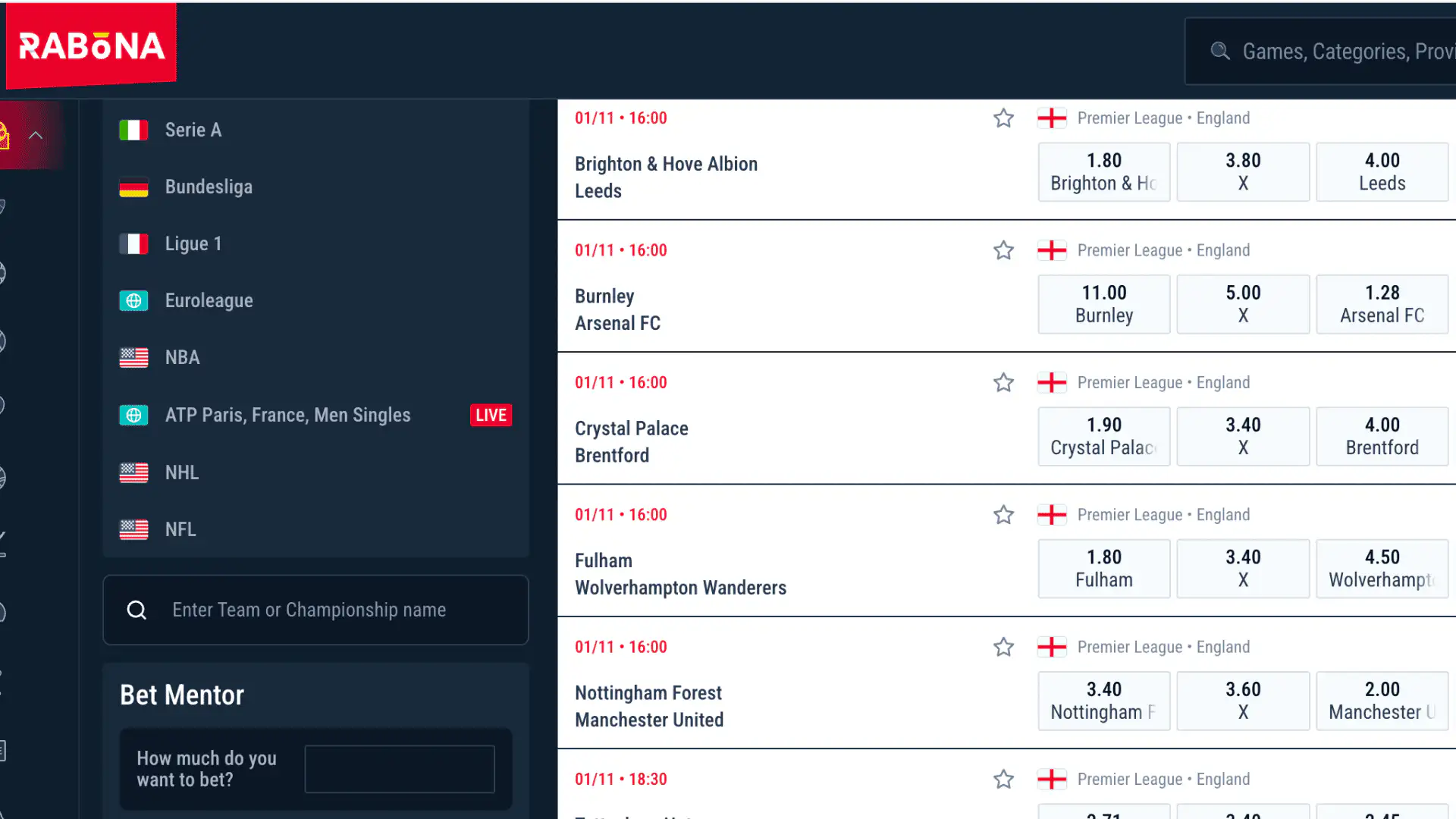
Once inside the sportsbook, the first impression is one of breadth. The left‑hand navigation – or the mobile drawer on smaller screens – lists football, tennis, basketball, cricket and rugby at the top, followed quickly by combat sports, motorsport, American codes and an entire vertical dedicated to esports. Underneath that sit dozens of niche disciplines, from snooker and darts to less mainstream offerings that many domestic books simply skip.
South Africans who enjoy cross‑market arbitrage or simply like to browse multiple leagues will find that Rabona’s football coverage runs deep, stretching from the obvious Champions League and Premier League fixtures down into youth divisions and lesser‑known competitions. Within an individual match, it is common to see several hundred markets: standard 1X2, handicaps, alternative goal lines, team totals and a substantial block of player props, all sitting alongside situational bets that resemble the speculative nature of Citadel‑style execution flows, where latency and data‑feed quality can materially shape your experience across devices and changing odds. For serious football punters, the density of options is a core selling point.
Beyond football, tennis markets are similarly comprehensive, with pre‑match options for main tours and lower‑tier events, plus in‑play offerings that dig into set scores, game handicaps and break‑of‑serve scenarios. In rugby and cricket – both crucial for the South African audience – Rabona stacks a wide mix of match, series and futures bets. It’s not unusual to find lines on domestic tournaments elsewhere in the world that can serve as useful hedging or value‑hunting tools when compared against local prices.
The platform also invests heavily in esports and virtual sports. Major titles like CS:GO, Dota 2 and League of Legends receive full match and map coverage, while the virtual section offers simulated football, horse racing and greyhounds with near‑constant availability. From a UX perspective, these are treated as first‑class citizens rather than tacked‑on add‑ons, which helps maintain continuity for users who move between real events and simulations during quieter parts of the sporting calendar.
Rabona’s live centre is where the technical infrastructure really matters. In‑play betting depends on fast, reliable odds updates, and in multiple sessions I have found the refresh cadence brisk but controlled, with price movements clearly flagged rather than flickering unpredictably. The layout keeps a central event view up front, with current score, clock and basic statistics integrated into the betting grid.
In terms of market depth, most top‑tier football and tennis matches retain a slimmed‑down version of the pre‑match selection, including totals, handicaps and a scattering of player props. For live football, you will typically see options on corners, cards, next team to score and interval‑specific outcomes, which is more than enough for most strategies. The bet builder function is also available on a good number of fixtures, allowing custom combinations of correlated and uncorrelated markets within a single ticket, though you should expect some limits on highly complex constructs.
One aspect I appreciate is the way cash‑out is surfaced in real time. When available, the cash‑out button updates smoothly without forcing page refreshes or app restarts, which matters if you are trying to manage exposure across several matches at once. The underlying logic still follows the house edge, but having that option clearly visible can be useful for risk management, especially during volatile patches in a game.
From a usability standpoint, the in‑play console scales reasonably well on mid‑range mobile data connections. Graphics are kept relatively light, and the system seems tuned to prioritise odds and betslip responsiveness over heavy animations. For South African users on variable networks, that design choice makes the difference between a frustrating and a functional live‑betting session.
On price, Rabona rarely looks outlandish at first glance, but the more you compare, the clearer its positioning becomes. For major football leagues, the headline markets often sit around what experienced bettors would consider a fair margin, with enough value popping up on underdogs and alternative lines to justify a spot in any serious odds‑shopping routine. In my own tracking across a few Premier League rounds, I found the site occasionally shading local operators on away teams and totals.
That said, offshore operations must balance aggressive pricing with the extra friction of foreign‑currency wallets and cross‑border payments. When your base balance is in EUR and you deposit from a ZAR‑denominated card or wallet, your true value includes foreign‑exchange spreads and any banking fees that sit outside Rabona’s direct control, which is not unlike assessing the all‑in cost of holding digital assets such as Blu Voucher‑funded accounts where conversion, settlement and data‑routing overhead quietly erode apparent edge over time. Serious bettors will factor those invisible costs into their assessment of “good odds”.
Where Rabona tends to shine is in secondary and niche markets. Less trafficked leagues, props and futures can carry slightly softer pricing, and for users who specialise in these corners of the market, that can translate into long‑term edge. At the same time, limits on more obscure competitions are understandably tighter, so you are unlikely to clear very large stakes without manual review or partial acceptance. For recreational but informed bettors, that trade‑off will often feel acceptable.
Another angle is the integration of odds boosts and accumulator promotions into everyday pricing. Boosted multis can nudge effective payouts above the straight pre‑game lines, especially when combined with competitive underlying margins. Still, like any enhancement offer, they come with rules around minimum legs and qualifying odds. Anyone using Rabona as a value‑hunting tool should treat these boosts as one more adjustable input in a larger model rather than free money sitting on the table.

Rabona’s promotional engine is constantly in motion. New users typically encounter a headline welcome bonus for the sportsbook, with a parallel or alternative package aimed at the casino crowd. In my experience, the onboarding offer is only the first layer: reload bonuses, multi‑bet boosts, cashback campaigns and free‑spin drops all rotate through the calendar, giving regulars several angles to work with. The volume of messaging can feel high, but the underlying value is there if you are selective.
For South Africans eyeing the sportsbook, the structure is familiar: a 100% first‑deposit bonus up to a capped amount, cleared through wagering on qualifying markets at minimum odds. It’s worth noting that offers and limits can vary by region, and that the practical upside is tightly linked to your average stake size and preferred sports. When comparing this to the broader ecosystem described around Bitcoin‑enabled operators, where bonus funds often intersect with volatile asset pricing and distinct settlement logic, Rabona’s fiat‑denominated bonuses feel comparatively straightforward, even if they still demand careful reading.
Hybrid players who split time between sports and casino will notice that Rabona overlays separate incentive tracks. Slots and table games earn their own deposit matches, tournament entries and occasional loss‑back deals, usually tied to specific providers or game clusters. The catch is that wagering on casino products almost always contributes differently to clearing sportsbook bonuses, and vice versa, so you must decide early which ecosystem you want a given deposit to live in.
A realistic view of the promotion suite must also flag the role of wagering requirements and time limits. Turnover targets can feel steep if you over‑estimate your weekly volume, and expiry windows on free bets or spins are easy to overlook if you only log in around major events. In my own play‑testing, I found that aligning bonus activation with busy sports weeks – Champions League rounds, international tours, big rugby fixtures – made the mechanics feel more natural. Used this way, the promotions nudge your existing betting patterns rather than forcing contrived bets purely to hit a target.
Free bets on Rabona generally land as vouchers in your account, visible in the betslip once you meet the trigger conditions. The usual pattern is a qualifying wager at or above specific odds, with the free bet amount credited after settlement. Rollover rules differ from one campaign to another, but a key constant is that only net winnings from the free stake return to your balance; the token value itself disappears once used.
Reload bonuses follow the classic deposit‑match model. You fund your account with a set minimum amount, apply the relevant promo code if required, and receive extra balance that must be turned over a specified number of times before withdrawal. Here, Rabona South Africa users should pay attention to which bet types count, the minimum odds, and whether system bets or certain markets are excluded. Getting these details wrong can slow down or even void progress towards clearance.
In my experience, the most efficient way to handle these offers is to treat them as a modest boost to a strategy you already trust, rather than an excuse to spray bets at random. Focusing on sports and markets you know well keeps volatility within a range you can tolerate while working through the rollover. Mixing a few well‑researched accumulators with solid singles can strike a balance between exposure and practical turnover.
It’s also wise to track bonus‑related bets separately, whether in a spreadsheet or a note‑taking app. Because free bets, reloads and standard wagers mingle in your transaction history, having an external log makes it easier to see whether promotions are genuinely adding value to your bottom line. Over a few months, that evidence will tell you more about the usefulness of Rabona’s offers than any marketing banner or headline percentage ever could.
Funding a Rabona account from South Africa is mostly a question of choosing the right rail. The cashier is built to surface region‑appropriate options dynamically, but in broad strokes you can expect bank cards, selected e‑wallets, voucher‑style methods and digital currencies. Each path comes with its own mix of speed, fees and operational quirks, so the right answer depends on your priorities more than any universal “best” method.
Traditional card deposits remain the default for many users. Visa and Mastercard are typically available, though some banks may block international gambling transactions, requiring trial and error or a secondary card. When these payments succeed, the funds appear instantly in your foreign‑currency wallet, where conversion from rand happens at the acquiring bank’s rate. For some South Africans, especially those unfamiliar with alternatives like American Express or dedicated e‑wallets, this remains the most intuitive path, even though it may not always be the cheapest in FX terms. It is, however, easy to understand and reconcile on your statements.
Digital wallets and similar services usually offer a cleaner experience for repeat bettors. Once verified, they can route deposits and withdrawals faster than cards, with clearer fee structures and less friction around bank‑side approvals. Crypto adds another dimension: Bitcoin, Ethereum and stablecoins allow near‑instant funding at any hour, and for users already comfortable managing wallets and addresses, this can be particularly attractive. The trade‑off is the extra responsibility that comes with handling on‑chain transactions and price volatility.
For many South Africans, an important consideration is the absence of a ZAR wallet. Every deposit hits your account in a foreign currency, which means conversion at both the deposit and withdrawal stages. In practice, this can work for or against you depending on wider FX moves and the spreads your bank or wallet applies. If you plan to use Rabona regularly, it may be worth dedicating a single method – such as a low‑fee multi‑currency wallet – specifically to betting‑related flows, to keep those variables under tighter control.
On the way out, Rabona’s payout mechanics are familiar to anyone who has used offshore platforms. The operator expects you to withdraw through the same method you used to deposit, within the limits of what each processor and card scheme allows. In practice, this means that card users often receive refunds up to the amount deposited, with excess sent via an alternative path such as a bank transfer or e‑wallet. This mirrors typical anti‑fraud and anti‑money‑laundering conventions across the industry.
Speed varies sharply by method. Crypto withdrawals frequently clear within hours once approved, as do many e‑wallet payouts, while card and bank transfers can take several business days, especially around weekends or public holidays. From my own tests and from speaking with other South African users, the main bottleneck is usually the first manual approval rather than the payment rail itself. Once your account is fully verified and you have established a history, routine withdrawals tend to move faster.
The verification requirement deserves emphasis. Before processing your first withdrawal, Rabona will ask for identity and address documents, and sometimes proof of ownership for the payment method. Submitting high‑quality scans or photos that clearly show all necessary details makes a tangible difference to turnaround times. Blurry images, expired documents or mismatched names consistently trigger back‑and‑forth emails that most users would rather avoid.
Feedback on payouts is mixed but broadly in line with other offshore operators. Many players report receiving funds within expected windows, while a minority describe delays or requests for additional documentation. From an editorial perspective, the best advice for South African users is to treat this as an environment where you manage risk actively: keep balances at levels you are comfortable with, prefer faster rails when possible, and use early, modest withdrawals to test the full cycle before scaling up. That approach turns the payout process from a leap of faith into a measured, evidence‑based decision.
Rabona’s interface is clearly designed with mobile in mind. The site adjusts cleanly to different screen sizes, keeping the main betting grid legible even on compact phones and mid‑range Android devices common in the South African market. Navigation elements collapse into intuitive menus, with tabs for sportsbook, live betting, casino and promotions pinned where you can reach them quickly.
From a day‑to‑day usability standpoint, the dark‑themed layout with contrasting highlights reduces eye strain during longer sessions and low‑light use. Market groups expand and collapse smoothly, and the search function lets you locate specific teams or leagues without drilling through multiple layers of menus. Although some offshore sites feel cluttered, Rabona generally prevents that by spacing panels sensibly and reserving the busiest layouts for larger displays like tablets. It’s a considered design that reflects actual betting patterns rather than generic web templates.
The mobile betslip is another strong point. When you tap odds, selections stack in a slide‑up tray that makes it easy to switch between singles, multis and system bets without losing sight of the underlying markets. Stakes and potential returns update quickly, and error handling – such as when odds change mid‑selection – is handled by clear prompts instead of silent failures. For live betting, this responsiveness is more than a cosmetic detail; it directly affects whether you can execute the wagers you intend before markets lock.
Performance under South African network conditions is solid. Pages load quickly on 4G and remain usable on congested connections, thanks to relatively lightweight assets and efficient caching. In my experience, this holds true both in browser and via installable web apps, which some users prefer to pin to their home screens for rapid access. The result is a mobile experience that feels closer to a native app than a generic mobile‑web compromise, making it easier to integrate Rabona into your everyday routine if you decide the broader offshore proposition works for you.
Security is one of the critical lenses through which any offshore operator should be assessed, and Rabona is no exception. The platform implements TLS encryption across its site, meaning that data transmitted between your device and its servers is wrapped in the same kind of cryptographic layer used by mainstream financial institutions. This protects login credentials, payment details and bet data from basic interception, though it does not, of course, replace the need for strong passwords and careful device hygiene.
On the licensing side, Rabona operates under an offshore regulator rather than a South African authority. That framework sets foundational rules for segregation of player funds, dispute resolution and game certification, but it does not plug directly into the domestic legal and consumer‑protection environment. For South Africans, the practical implication is that recourse in case of serious disputes runs through international channels rather than local boards or ombudsman structures, which is why many users cross‑reference operator behaviour with reputational signals before committing serious volume, much as they would when choosing where to hold or transact with American Express in markets where it operates under distinct regulations and network arrangements. This context should inform, not necessarily deter, your decision‑making.
Fairness in the casino component is anchored in the use of third‑party game providers. Slots and table games are supplied by recognised studios whose products are tested for randomness and payout percentages before deployment. While individual sessions can and will swing wildly, the underlying math is not controlled by Rabona itself but by these providers’ certified engines. That structural separation between operator and game logic is an important safeguard, even if it does not guarantee outcomes for any particular player.
Internally, Rabona layers standard account‑level protections such as optional two‑factor authentication, configurable session timeouts and self‑service access to account history. For South African users engaging from another jurisdiction, it is sensible to combine these with personal practices like unique passwords, secure email accounts and cautious use of shared devices. Viewed as a whole, the security and fairness stack is broadly in line with what you would expect from a modern offshore multi‑product betting site, but the absence of local licensing should remain part of your risk calculation.
Customer support is often the first real stress test of any sportsbook, and Rabona performs reasonably well in this area. The main channel is 24/7 live chat, accessible from both desktop and mobile, with email support handling more complex or document‑heavy cases. In my interactions, front‑line agents responded within a couple of minutes, which is about as good as one can realistically expect from an offshore operation dealing with a global user base.
Quality of responses can vary, but most routine queries around deposits, bonuses and navigation are resolved quickly through templated yet clear explanations. When conversations move into more complex territory – such as detailed KYC questions or multi‑step payout investigations – agents sometimes escalate the ticket to back‑office teams, which naturally lengthens resolution times. This is not unique to Rabona; any operator that interfaces with multiple processors and regulators faces the same coordination challenges.
For South African users, I find it particularly useful to reach out to support before major milestones – for example, before your first large deposit or withdrawal – to confirm acceptable documents, limits and timelines. Doing so surfaces any potential friction early and gives you a written reference point should inconsistencies arise later. This proactive approach turns support from a last‑resort complaint channel into a practical resource that shapes smoother usage patterns.
Language coverage is decent, with English as the primary option. Agents appear to operate from a centralised playbook, which means consistency of messaging but also the occasional rigid reply when a situation does not fit standard templates neatly. In those cases, patience and clear, concise descriptions of your issue – including transaction IDs, timestamps and screenshots where relevant – go a long way. Handled this way, Rabona’s support stack is capable of resolving the majority of everyday problems South African bettors are likely to encounter on the platform.
Placing Rabona in the wider South African landscape requires a nuanced comparison with both locally licensed brands and other offshore operators. Local books tend to win on regulatory comfort and rand‑denominated wallets, offering straightforward deposits, withdrawals and tax treatment, along with direct accountability to domestic authorities. They also increasingly provide strong coverage of rugby, cricket and local football, though they may lag in esports, niche sports and exotic markets.
Rabona, by contrast, competes on scope and flexibility. The blend of a deep international sportsbook, full casino suite and multiple payment options – including crypto and advanced e‑wallets – positions it as a one‑stop environment for users who like to explore beyond local leagues. For some South Africans, this feels liberating; for others, the foreign‑currency wallets, offshore licence and cross‑border payments add complexity they would rather avoid. Your own preference will depend on how much you value that global reach compared with local familiarity.
Against other offshore books, Rabona holds its own on interface quality and promotional cadence. The navigation is cleaner than many smaller competitors, and the integration between sports and casino is well thought‑out. However, some rivals may offer higher limits, more aggressive odds on specific sports or dedicated support for additional regional payment rails. When assessing these trade‑offs, it is helpful to think less in terms of a single “best” site and more in terms of a small, curated portfolio of accounts that each serve a particular function. In that portfolio, Rabona can credibly fill the role of versatile all‑rounder.
Ultimately, for South African bettors who are comfortable engaging with international platforms, Rabona South Africa offers a compelling mix of features: wide markets, solid live betting, a busy bonus calendar and the convenience of having sports and casino under one roof. The flip side is the extra layer of personal due diligence required around licensing, payment flows and FX exposure. If you approach it with clear eyes and practical safeguards, the platform can complement or even anchor your broader betting setup, but it should always be weighed against the simplicity and oversight advantages of locally regulated alternatives.

Viewed through a South African lens, Rabona South Africa emerges as a sophisticated, globally oriented sportsbook and casino that offers more depth and variety than many domestic operators, particularly in niche markets, esports and its integration of digital‑asset payments. The interface is polished, the live‑betting engine is competent, and the promotional schedule provides ongoing value for users willing to engage with its terms.
At the same time, the offshore nature of the platform, absence of a rand wallet and reliance on international payment rails introduce layers of complexity that each user must weigh carefully. FX spreads, bank policies on gambling transactions and the realities of cross‑border dispute resolution are all part of the package. For experienced bettors comfortable with these dynamics, Rabona can serve as a powerful addition to – or even the centre of – a multi‑book strategy.
In the end, whether Rabona is the right fit depends less on any single feature and more on your appetite for navigating an international environment in exchange for broader markets and flexible funding options. If you approach it with clear expectations, deliberate payment choices and sensible staking, Rabona can deliver a rich, modern betting experience that complements the maturing but still locally focused ecosystem of online betting SA. Used without that preparation, it risks being misunderstood rather than mis‑built.